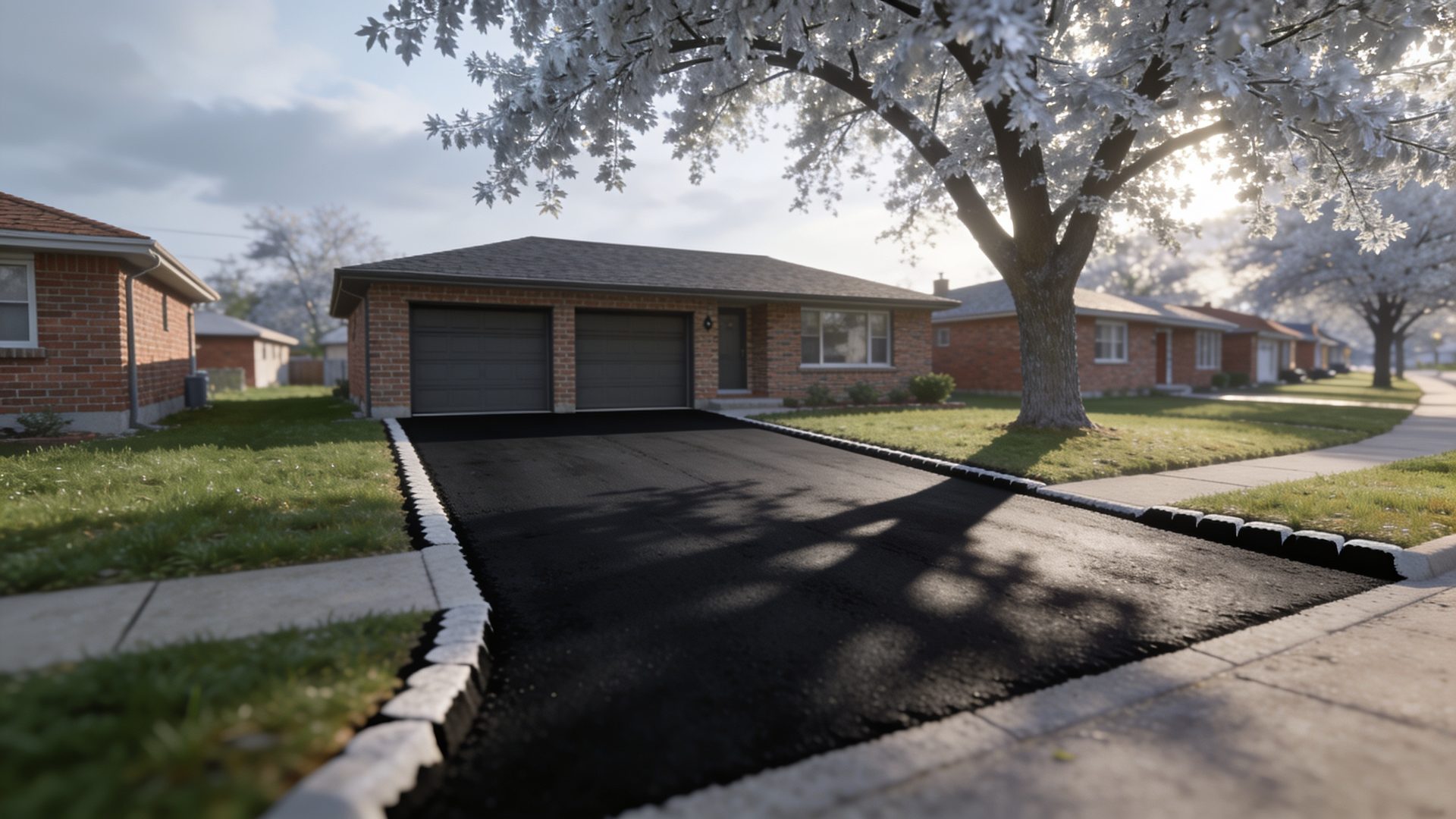
Livonia is 35.7 square miles of Wayne County laid out on the mile-road grid, and its pavement history is unusually easy to date. The township incorporated as a city in May 1950 with about 17,000 residents. It crossed 100,000 by 1998 and stood at 95,535 in the 2020 census, with 40,380 housing units and an owner-occupied rate of 86.6 percent. The building happened in a compressed window in the middle of that. What it means practically is that a very large share of Livonia driveways were poured or paved between roughly 1955 and 1975, and are now either original pavement well past its design life or a first replacement laid in the 1980s and 1990s that is itself getting old. Original pavement that far along is usually a candidate for new asphalt paving rather than another coat of sealer, while a first replacement with a sound base is still worth protecting.
Not all of it is that era. Rosedale Gardens, platted by the Shelden Land Company in the 1920s in the southeast corner between Plymouth Road and West Chicago, is older: 428 houses stood in the original section by 1948, and about 570 were built there between 1925 and 1960. The district went on the National Register in July 2010. Those streets carry narrower drives, more original concrete, and asphalt that in many cases was laid over something else. That changes the repair conversation, because an asphalt overlay on an old concrete slab cracks in a reflective pattern that tracks the joints underneath rather than the weather.
What sits under all of it matters more than most homeowners realize. The till across this part of Wayne County is the Blount type: formed in glacial till on wave-worked till plains, somewhat poorly drained, with a particle-size control section that averages 35 to 45 percent clay and low saturated conductivity in the dense till below. Clay does not drain. Water that gets past your pavement into the base tends to stay there. When it freezes it lifts, and when it thaws, fine-grained soil can approach its liquid limit and stop carrying load altogether. CBS Detroit's explainer on Michigan's pothole problem names clay-heavy soils as a contributing factor for exactly this reason.
Then the weather does the work. NOAA's 1991-2020 normals for Detroit Metro Airport, the nearest first-order station and about eleven miles due south of Livonia, record 115.4 days a year at or below 32 degrees and 41.3 days where the temperature never gets above freezing at all. The difference, roughly 74 days, is the count of days the pavement drops below freezing and comes back up. Thirty-eight of those fall in December through February, about 23 in spring, and about 14 in the fall. Snowfall normal is 42.5 inches a year, and 13.1 days a year bring an inch or more at once.
Winter maintenance in Livonia is split. Wayne County's Department of Public Services handles most of the major roads, running rock salt pre-wet with liquid brine across about 4,500 lane miles with more than a hundred trucks, and it built a new salt dome in Plymouth Township, just west of Livonia, in the summer of 2024. The city handles approximately 360 miles of neighborhood streets on a tiered plan: primary arterial routes salted and plowed around the clock as needed, secondary routes on weekdays, and everything else as conditions allow. Four to eight inches triggers a snow emergency and city-wide plowing. Over eight inches is the same response over a longer stretch of time.
All of that salt has to come from somewhere, and in this region it comes from underneath. The salt beds beneath Michigan formed roughly 400 million years ago in the Michigan Basin, and Detroit has a working mine reached by a shaft first sunk to 1,060 feet in 1910. MDOT's Metro Region spread more than 111,000 tons in the 2025-26 winter, about 35 percent above its average. Statewide, the trunkline system runs 9,700 miles and county road agencies handle another 90,500. The guide to road salt and Livonia driveways covers what that actually does to blacktop, which is not quite what most people assume.